

News
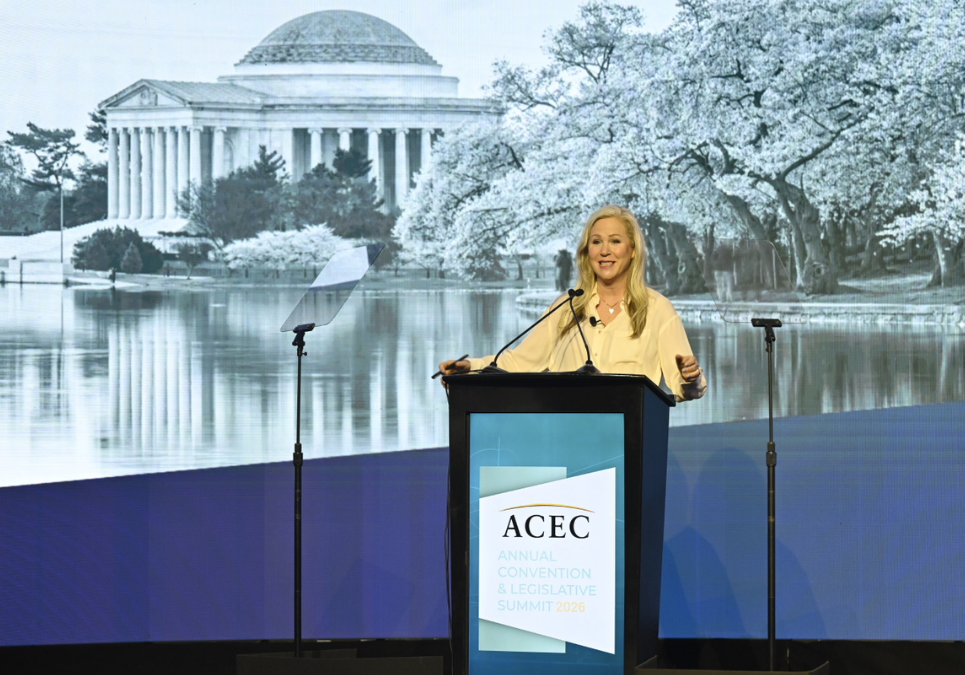
ACEC President and CEO Linda Bauer Darr began her remarks to this morning’s opening general session by asking attendees to turn their attention to the water pitchers sitting in the middle of every table in the Grand Hyatt Washington’s Independence Ballroom. Noting the clarity and safety of the water in each pitcher, she then referenced a “60 Minutes” segment about McDowell County, West Virginia—a town five hours from our nation’s capital in which the water is too dangerously polluted to consume.
That story formed the framework of Darr’s remarks, which focused on the role of engineers in bridging the innovative and the essential. “We talk about the digital divide,” she said. “But what about the water divide? The health divide?” In a moment marked by deep political division and dazzling technological advances, one thing that should unite us is our commitment to ensuring universal access to the basics of life. Darr shared a conversation she had recently with a prominent Senate leader. Appearing tired and frustrated, this lawmaker confided that he wasn’t cut out for “this climate of performative politics.” He longed to return to the days of legislating around things that matter — “the kinds of things that WE do,” Darr said.
Despite a political climate marked by contention and conflict, there are real opportunities to make the case for the essentiality of engineering. McDowell County, WV is not the outlier we all wish it were. It’s a story one can find in every state across our country—a story of social compacts being broken and citizens suffering because of it. And that, Darr urged attendees, is what our citizen lobbyists must emphasize to our lawmakers and their staff this week. “The dysfunction of this moment,” she said, “is not an excuse to wait this out. Every moment spent on performance rather than purpose is a moment we don’t get back.”
With Congress set to mark up a new surface transportation bill—and with water legislation not far behind—the time has never been better to drive home the importance of what we do. As Darr said in her remarks to the Board: “Infrastructure is politically durable.” Six months out from a pivotal midterm election, safe roads and clean water should be an easy “yes” for lawmakers.
But leave politics out of it for a moment because there is so much more at stake. From its earliest days, engineering, Darr said, has always been a civic act. “The bridges, the railroads, the water systems—these weren’t just engineering feats. They’re declarations that distance, danger, and hardships were problems to be solved, not conditions to be accepted.”
“Engineering didn’t just build the modern world,” she said. “It dignified it.”




Date
May 4, 2026
Category
Topic