

Resource
Overview
Artificial intelligence is rapidly reshaping engineering practice, creating new opportunities to improve productivity, decision-making, project delivery, and client value. But as AI becomes embedded across engineering firms, it is also introducing risks that extend far beyond the technology itself.
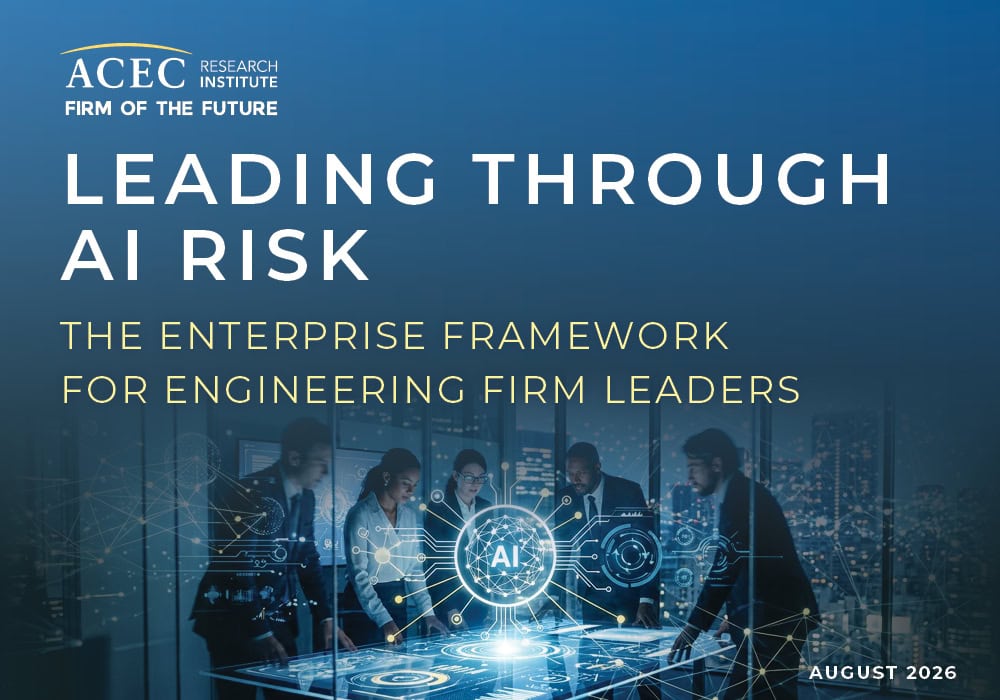
Leading Through AI Risk: The Enterprise Framework for Engineering Firm Leaders examines the risks AI creates across the engineering enterprise and provides a practical framework to help firms identify, govern, and mitigate them responsibly.
The study draws on an extensive literature review and in-depth interviews with 21 leaders across the engineering ecosystem.
Why This Matters
Engineering decisions can directly affect public safety, critical infrastructure, client trust, and professional liability. As AI capabilities advance, firms must consider not only whether AI tools work, but how they affect professional judgment, accountability, data, talent, operations, and the organization itself.
The research finds that AI risk is fundamentally an organizational challenge, not simply a technology challenge. Responsible adoption requires an enterprise-wide approach to governance, risk management, and organizational readiness.
Key Findings
The research identifies eight interconnected domains that define the AI risk landscape for engineering firms:
- Technical Reliability and Model Risk: AI-generated outputs require rigorous verification and professional review.
- Professional Liability and Standard of Care Risk: Licensed engineers remain responsible for engineering decisions regardless of how AI is used.
- Data Governance, Privacy and Intellectual Property Risk: Well-governed data is essential to successful AI implementation.
- Organizational and Workforce Risk: Firms must rethink how engineers develop judgment, skills, and experience in an AI-enabled environment.
- Ethical, Regulatory and Reputational Risk: Transparency, accountability, and responsible governance are essential to maintaining public trust.
- Operational and Cybersecurity Risk: AI must be integrated into existing quality, cybersecurity, business continuity, and risk management processes.
- Financial and Business Model Risk: Competitive advantage will depend on using AI to create client value, not simply internal efficiency.
- Strategic Leadership and Enterprise Governance Risk: Leadership, governance, culture, and organizational capability ultimately determine successful AI adoption.
A Central Finding
Artificial intelligence does not reduce the engineering profession’s responsibility. Instead, it raises the standard for governance, engineering judgment, and organizational leadership.
Across stakeholder groups, the research found strong agreement that engineers remain responsible for the quality of the work they deliver, regardless of how AI is used.
What This Means for Engineering Firms
AI risk cannot be managed by the IT department alone. Firms need coordinated action across engineering, operations, technology, legal, human resources, and executive leadership.
At the same time, firms must balance the risks of AI adoption with the risks of inaction as clients, competitors, technology providers, and infrastructure owners increasingly embrace AI-enabled ways of working.
Bottom Line
The question facing engineering firms is no longer simply whether to adopt AI, but how to adopt it responsibly.
Firms that strengthen governance, professional judgment, workforce development, data stewardship, and organizational accountability will be better positioned to capture AI’s benefits while protecting clients, preserving professional standards, and maintaining public trust.
Access the Full Report
Download Leading Through AI Risk: The Enterprise Framework for Engineering Firm Leaders to explore the eight AI risk domains and practical guidance for managing AI responsibly across the engineering enterprise.
Additional Resources:
Recording: Future of Engineering Roundtable: Managing AI When You Don’t Understand its Risks
ACEC Research Institute AI Risk Leader Guides